A piano is one of the heaviest, most fragile, and most valuable things in any home. It can weigh up to 1,300 lbs, yet a single bump can crack its soundboard or knock its 200+ strings out of tune. If you are wondering how to move a piano without damaging it, your floors, or your back, this guide walks you through every step.
Quick answer: To move a piano safely, measure the route, wrap the piano in moving blankets, use a piano dolly (or a skid board for grands), have at least three to four people, and strap it securely in the truck.
You will learn how much different pianos weigh, what equipment you need, how to move an upright piano and a grand piano step by step, how to handle stairs, and which mistakes cause the most damage. We also cover the challenges that are unique to moving a piano in the Bay Area, from San Francisco hills to high-rise elevators.
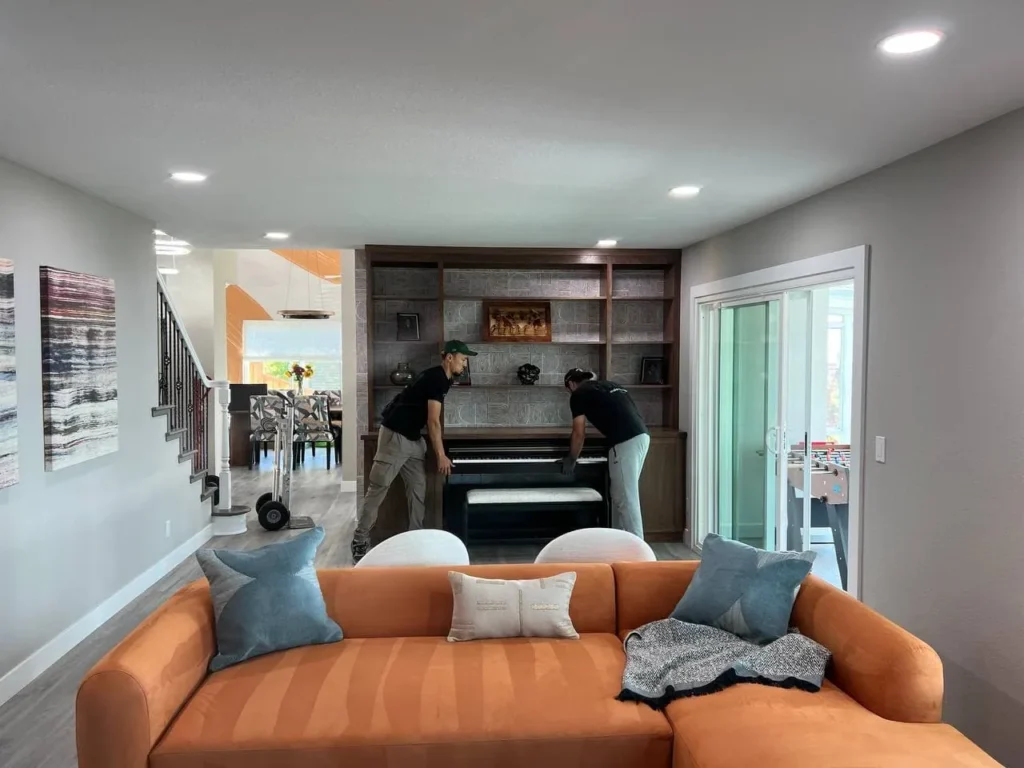
Why Moving a Piano Is Harder Than It Looks
The challenge is not just weight. Most of a piano’s mass sits in its cast-iron plate, which makes it top-heavy and unevenly balanced. Inside, thousands of moving parts sit under constant string tension. Legs, pedals, and casters are decorative or built for small adjustments, not for carrying the instrument across a room.
| Piano type | Average weight (lbs) | Typical size | Minimum people needed | Difficulty |
|---|---|---|---|---|
| Spinet | 300–400 | 36–39 in tall | 3 | Moderate |
| Console | 350–450 | 40–44 in tall | 3 | Moderate |
| Studio upright | 400–500 | 45–48 in tall | 3 | High |
| Full upright | 500–800 | 49–60 in tall | 3–4 | High |
| Baby grand | 500–650 | 4’11″–5’6″ long | 3–4 | Very high |
| Parlor grand | 600–750 | 5’7″–6’4″ long | 4 | Very high |
| Concert grand | 900–1,300 | 8’11″–9’6″ long | 4+ | Extreme |
Weights and sizes are approximate and vary by manufacturer and age.
Equipment You Need to Move a Piano
Moving a piano safely starts with the right tools. Furniture dollies and good intentions are not enough.
- Piano dolly: a heavy-duty, low-profile dolly rated for at least 1,000 lbs that keeps the weight stable while rolling.
- Piano board (skid board): a padded board that a grand piano rests on, on its side, during the move.
- Moving straps: ratchet or lifting straps that lock the piano to the dolly or board and help distribute the load.
- Moving blankets: thick padded blankets that protect the finish, keys, and corners from scratches and dents.
- Stretch wrap: holds the blankets in place without adhesive touching the finish.
- Work gloves: improve your grip on a smooth, polished case.
- Ramps: help you cross thresholds, curbs, and the gap into the truck without lifting.
- Screwdriver: for removing a grand piano’s legs, pedal lyre, and lid hinges.
How to Move an Upright Piano: Step by Step
Uprights are the most common home pianos, and they are deceptively hard to move. Here is how to move an upright piano with minimal risk.
- Measure the route. Measure the piano, every doorway, hallway, and turn along the path. Plan where the piano will stand in the new room before you lift it.
- Clear the path. Remove rugs, furniture, and anything you could trip over. Lay floor protection on hardwood and tile.
- Secure the lid and keys. Close and lock the fallboard (key cover) and top lid. If there is no lock, wrap them shut with a blanket and stretch wrap.
- Wrap the piano. Cover the entire case in moving blankets, paying extra attention to corners, pedals, and the keyboard side. Hold the blankets in place with stretch wrap, never tape on the finish.
- Lift by the case, not the legs. With at least three people, lift from the bottom of the case at each end and set the piano onto the piano dolly. Keep it upright at all times.
- Strap it down. Secure the piano to the dolly with straps so it cannot tip or slide.
- Roll slowly with a spotter. One person guides, one or two push, and one watches for obstacles and calls out stops. Use ramps for thresholds and steps.
- Load and secure in the truck. Place the piano with its back against the truck wall and strap it to the rails.
- Unload and position. Reverse the process. Place the piano on an interior wall, away from windows, heaters, and air vents.
How to Move a Grand Piano: Step by Step
A grand piano is a different job altogether. It has to be partly disassembled and moved on its side. If you are learning how to move a grand piano for the first time, read every step before you start.
- Remove the music desk. Slide it out and wrap it separately.
- Close and secure the lid. Remove the lid prop. On many models the lid is removed entirely by unscrewing its hinge pins; wrap it separately.
- Remove the pedal lyre. Unscrew it from the bottom of the case, noting how the pedal rods connect. Label every screw.
- Wrap the body. Cover the case completely in moving blankets and stretch wrap, with extra padding on the straight (left) side it will rest on.
- Position the piano board. Place the padded skid board alongside the piano’s straight side.
- Remove the first leg and lower the piano. While two or three people support the weight, remove the front leg on the straight side and carefully tip the piano down onto the board on its straight side.
- Remove the remaining legs. With the piano on the board, unscrew the other two legs and wrap them.
- Strap the piano to the board. Use at least two straps, then lift the board onto a piano dolly.
- Transport on its side. Keep the piano on its straight side for the whole move, strapped to the truck wall.
- Reassemble in reverse. Lift the piano upright on the board, attach the legs one at a time, then the lyre and lid. Check that it sits level.
Grand pianos are common in luxury homes in communities like Hillsborough, Atherton, and Saratoga, and they are exactly the pieces where professional handling pays for itself.

How to Move a Piano Upstairs or Downstairs
Stairs are where most piano accidents happen. The rule professionals follow is simple: the strongest, most experienced person always stays below the piano, because gravity shifts the weight toward the lower end.
Here is the safe technique if you need to move a piano downstairs or upstairs:
- Place a ramp or a stair-climbing dolly on the steps if you have one.
- Tilt the piano slightly onto its back edge so the lower person can support the base.
- Move one step at a time, with the team calling out each step together.
- Rest on every landing. Never let the piano sit unsupported on a stair.
- Keep spotters at the top and bottom to watch for walls, railings, and turns.
If you are figuring out how to move a piano upstairs, DIY is unsafe if the staircase turns, has more than a few steps, lacks a sturdy handrail, or if you are moving a grand. In those cases, the risk of injury and property damage is too high.
Piano Moving Tips: Mistakes That Damage Pianos
These are the most common errors, and the piano moving tips that help you avoid them:
- Lifting by the legs. Upright and grand legs are not load-bearing for lifting. They snap.
- Rolling on the piano’s own casters. They are decorative or meant for small adjustments and can gouge floors or break off.
- Tilting a grand without removing the legs. This puts enormous stress on the leg joints and the case.
- Laying an upright on its back or front. This can damage the action and keys. Keep uprights upright.
- Taping directly onto the finish. Adhesive can pull off lacquer and polish.
- Too few people. Three is the minimum for most uprights; four or more for grands.
- Skipping the measurements. Getting stuck halfway through a doorway is how walls and cases get damaged.
- Leaving the piano unsecured in the truck. A single hard brake can tip it.
- Placing it near heat or windows. Sun, heaters, and vents cause cracks and tuning instability.
- Tuning immediately after the move. The piano needs time to adjust to its new room first.
After any move, plan to have the piano tuned once it has settled into its new room, usually two to four weeks later. The Piano Technicians Guild keeps a directory of technicians if you need one in your new area. Knowing how to move a piano is only half the job; a tuning afterward brings it back to pitch.
Moving a Piano in the Bay Area: Local Challenges
Moving a piano in the Bay Area comes with obstacles you will not find in most of the country. If you are moving in San Francisco or anywhere around the Bay, plan for these:
- Steep hills and driveways. Many San Francisco and Marin streets are too steep to roll a dolly safely. The truck has to be parked strategically and the piano secured against rolling at every stage.
- Victorian and Edwardian homes. Narrow front stairs, tight turns, and slim doorways make a simple upright move feel like a puzzle. Measure everything twice.
- High-rise buildings. Condo towers usually require an elevator reservation, a padded freight elevator, a set moving window, and a certificate of insurance (COI) from the mover before move day.
- Parking permits. In San Francisco, reserving curb space for the truck generally means requesting a temporary no-parking permit from the SFMTA well in advance. Without it, the crew may carry the piano a long way down the block.
- Microclimates. Coastal fog and humidity in San Francisco differ sharply from the dry heat of San Jose or Walnut Creek. A piano moved between them will drift out of tune as its wood adjusts.
That last point matters: wait 2–4 weeks before tuning a piano after a move so it can acclimate to the new room’s temperature and humidity. Tuning it sooner usually means paying for a second tuning.

DIY vs. Professional Piano Moving
| Factor | DIY | Professional movers |
|---|---|---|
| Cost | Dolly and truck rental, plus help from friends | Higher upfront, priced by piano type, distance, and access |
| Equipment | Usually rented or improvised | Piano boards, rated dollies, straps, ramps, stair climbers |
| Risk of injury | High, especially on stairs | Low, with trained crews and proper technique |
| Risk of damage to piano or home | High: dropped cases, gouged floors, dented walls | Low, with full padding and floor protection |
| Insurance coverage | Usually none | Valuation coverage and liability insurance available |
| Stairs and tight spaces | Often unsafe | Routine with the right tools |
| Time | A full day of planning and lifting | Typically a few hours |
DIY can be reasonable for a small spinet or console moving a short distance on one floor, with no stairs and at least three strong helpers. For a grand piano, any staircase, a high-rise building, or an instrument with real financial or sentimental value, moving a piano yourself is rarely worth the risk.
How to Choose Piano Movers
Not every moving company is equipped for pianos. Before you book, confirm the company holds a California household goods permit (you can verify it with the Bureau of Household Goods and Services), then check that the mover offers:
- Specialized piano equipment: skid boards, piano dollies, and stair climbers, not just furniture dollies.
- Insurance: valuation coverage for the instrument and liability coverage for your home and building.
- Experience with grands: ask how many grand pianos the crew has moved and how they handle disassembly.
- A written quote: a clear price that accounts for stairs, distance, and access, with no surprise fees.
- References and reviews: look for past clients who moved instruments similar to yours.
A mover that also provides residential moving and furniture moving services can handle the piano as part of your full household move, so it is protected and placed alongside everything else.

Need Professional Piano Movers in the Bay Area?
Now you know how to move a piano safely and why every step matters. If your instrument is a grand, your home has stairs, or you do not want to risk it, CEO Moving’s crews handle pianos with the same white-glove care we bring to every high-value item, whether it is a local move or one of our long-distance moves. Looking for experienced piano movers in the Bay Area? Request a free quote and get a clear, written price before move day.